
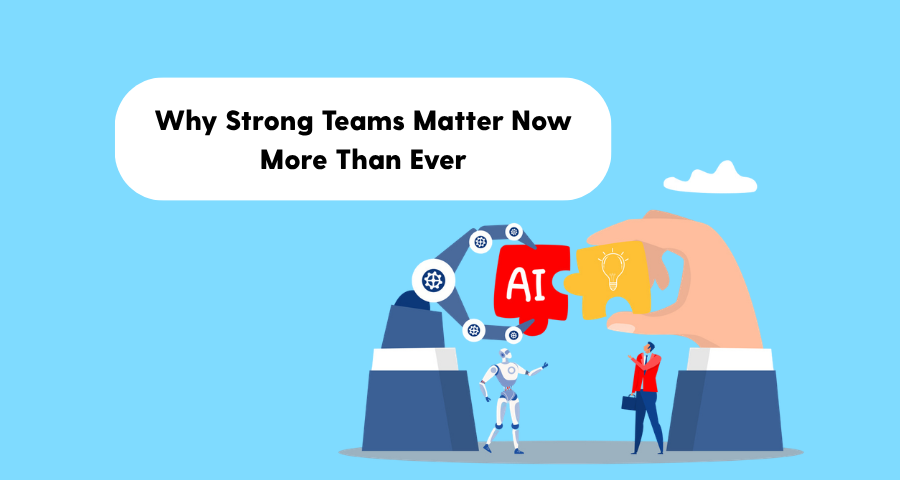
We’re living through another major period of technological development. Artificial Intelligence (AI) is evolving rapidly and becoming increasingly adopted across almost every industry. Every few weeks, there seems to be a new tool, headline or prediction about what AI will change next.
Naturally, organisations are always looking for ways to improve efficiency, reduce costs and remain competitive. However, amid the hype around AI helping businesses do more with less, there’s a risk that the people who keep the organisation running begin to feel secondary. As we will highlight below, building strong teams in the age of rapid technological change is more essential than ever.
AI can do a lot, but it is still people who drive creativity, critical thinking, emotional intelligence, judgment, and adaptability within a business. These human qualities remain incredibly difficult to replicate, automate, and authentically replace with machines.
While people can be complex and managing teams comes with its own challenges, they are also the ones who can:
- solve problems creatively
- navigate ambiguity
- build trust and relationships
- understand nuance and context
- adapt when plans fail
- bring empathy and perspective into the workplace
AI is an incredibly powerful tool that can support these capabilities, but it does not replace them. Technology may optimise processes and improve efficiency, but strong businesses are still built by strong teams.
Be Wary of Technological Hype Cycles
It can be exciting to hear how new technology may revolutionise your business. However, the evolution of self-driving cars serves as a useful reminder that technological hype does not always align with practical reality. Despite decades of development and enormous investment, autonomous vehicles still require significant human oversight and intervention in many real-world situations.
A case study examining the German Act on autonomous driving analysed many of the promises surrounding its capabilities. As the piece highlighted, the ongoing challenges around safety, regulation, trust, accountability and human interaction that were raised in the early stages continue to slow widespread adoption and development years on.
The rollout of self-driving cars reminds us that transformative technologies are often far more complicated to integrate in practice than early narratives suggest. Technologies do not operate in isolation from human behaviour, organisational systems, regulation, ethics or real-world unpredictability. As a result, adoption frequently takes longer, requires more human involvement and yields more mixed outcomes than initial hype cycles suggest.
Businesses should approach the rapid rise of AI with caution. The current enthusiasm and urgency around its adoption echo past market fervours. Lessons from the development of self-driving cars suggest organisations should not overlook proven human strengths in pursuit of technological promises that are still evolving.
The Risk of Neglecting Proper Change Management
As the promise and capabilities of AI grow, it can be tempting to aggressively restructure teams or replace existing processes to adopt it. There is often pressure to move quickly and adopt new tools early, or risk missing out on the competitive advantage promised by innovators. As a result, organisations can rush implementation without fully considering the long-term impact on operations, workplace culture or workforce capability.
Ironically, overly rushed and poorly managed change can undermine the very performance businesses are trying to improve, particularly when trust in teams and leadership begins to erode.
Good change management has never been about blindly adopting every trend. It is about balancing innovation with stability and ensuring new systems, including AI, are integrated in ways that strengthen the business rather than disrupt what is already working well.
Balancing People and Technology
During periods of rapid technological change, things like culture, connection, learning, belonging, recognition, and wellbeing can quickly become “nice-to-haves”. However, neglecting them comes at a cost.
When people feel uncertain, undervalued or disconnected during organisational change, engagement and adaptability often decline. Research consistently shows that psychological safety, meaningful work and employee support are critical drivers of engagement during periods of workplace change.
The strongest organisations are creating environments where employees feel:
- equipped to adapt
- supported through change
- trusted to contribute
- involved in decision-making
- valued beyond productivity metrics
As AI becomes more widespread, technology alone will become less of a differentiator. Over time, many businesses will have access to similar tools. As Deloitte’s 2026 Global Human Capital Trends research suggests, the organisations that will succeed long-term won’t simply be the ones adopting technology the fastest. They’ll be the ones that balance technological progress with genuine investment in their people.
What HR Leaders and Businesses Should Focus On
1. Manage technology like any major organisational change
AI adoption should not simply be treated as a software rollout. It impacts workflows, expectations, confidence, accountability and workplace culture.
Clear communication, training and support matter just as much as the technology itself.
2. Keep people learning
The tools will continue to evolve. Your team’s ability to evolve alongside them is what matters most.
Research published by Harvard Business Review highlights that investing in learning, development and upskilling helps employees feel capable rather than threatened by change. People who feel invested in are generally more engaged, adaptable and better equipped to help businesses navigate uncertainty.
3. Create environments where people still feel human
Efficiency matters, but so does connection, wellbeing and belonging.
Creating a positive workplace culture that recognises and supports people remains critical, especially during periods of rapid change.
4. Use technology to enhance human capability, not diminish it
The most effective use of AI is often alongside people, not instead of them.
The goal shouldn’t always be replacing human contribution. Often, the greatest value comes from freeing people up to focus on higher-value thinking, creativity, strategy and relationship-building.
Questions Leaders Should Be Asking
As AI continues to evolve, leaders need to think carefully about how humans and technology work together within their organisations.
Some important questions to consider include:
- How can we balance efficiency with employee wellbeing?
- Where does human judgment still need to lead?
- How do we ensure accountability, privacy and legality when using AI systems?
- How is technology impacting our workplace culture?
- Are we helping our people adapt, or simply expecting them to keep up?
- How can technology strengthen human performance rather than replace it?
The Bottom Line
Technology will continue to evolve, and the hype cycles will continue to rise and fall. The grass can often appear greener during periods of technological excitement, yet replacing what already works with systems that remain relatively new and underexplored can create unintended instability.
What will define successful businesses in the long term is the strength of the teams behind them and how well those people are supported through change.
At the heart of every organisation, workplace and industry, it is still people who move the needle. They are not merely a line item to optimise. They are your competitive edge.
Technology can absolutely improve performance, efficiency and innovation. However, when it is paired with strong human teams, thoughtful leadership and healthy workplace culture, that is where businesses create lasting value.
Looking after your workforce is not separate from business strategy – it is business strategy.
Read more ways you can effectively support your team on the Boost blog.